1 of 38
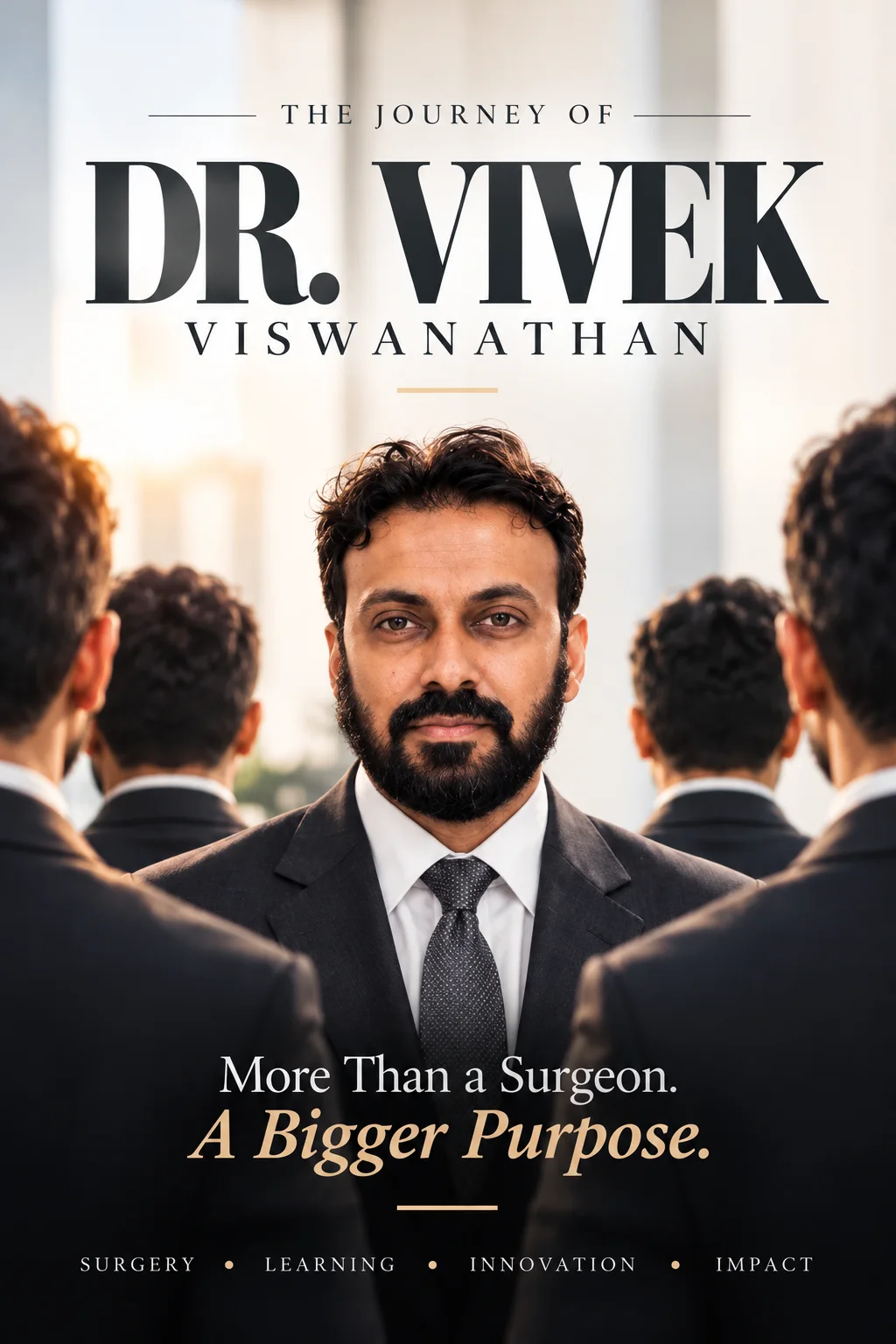
More Than a Surgeon
1 / 1
Contents
- Meet Dr. Vivek Viswanathan3
- Where it begins5
- The making of a surgeon7
- How the work began10
- The part that is never photographed12
- What he has built15
- Research, and why it is not a number17
- A book for the parents19
- Technology, and what it is for21
- A world record, by accident of subject23
- Where the work has been noticed25
- The turns that mattered27
- The people who built him29
- What he believes31
- What he is building towards34
- In his own words36
More Than a Surgeon
Meet Dr. Vivek Viswanathan
He is a Consultant Paediatric Surgeon and Urologist, with a particular interest in robotic, laparoscopic and minimally invasive surgery in children.
His patients are born with conditions that have to be corrected before a life can properly begin — congenital surgical problems, disorders of the urinary tract, complex reconstructive work. The margin for error in that work is measured in millimetres, and the person on the table is usually too small to tell you where it hurts.
3 / 38
More Than a Surgeon
Three interests have shaped everything he has built, and they are not separable: clinical excellence, education and innovation.
Alongside operating, he teaches medical students and surgical trainees, carries out academic research, writes, and works on the responsible application of technology and artificial intelligence in healthcare.
I have always felt that being a doctor is much larger than performing a procedure. A good surgeon must understand the science, but also the child, the family, the fear, the expectations and the responsibility that comes with being trusted with someone’s most precious person.
4 / 38
More Than a Surgeon
Where it begins
He grew up in a house that valued education, discipline and curiosity — and, more particularly, the idea of doing something well rather than merely doing it.
Books came early and stayed. He has always been held by the way knowledge can change what a person is able to see.
5 / 38
More Than a Surgeon
Music came too, and it has never left. Hindustani classical vocal and tabla remain part of his life.
That is not a decorative detail. Classical music taught him what surgery would later teach him again in an entirely different language: that mastery is built out of repetition, patience, listening and attention to detail. There is no shortcut in either discipline, and both punish the person who looks for one.
Curiosity, persistence, attention to detail, the appetite to keep learning — the qualities that define his professional life were visible long before he had a profession.
6 / 38
More Than a Surgeon
The making of a surgeon
Medicine drew him for two reasons at once: a fascination with science, and the wish to work somewhere that knowledge could directly improve another person’s life.
He completed his medical education and trained in surgery, eventually specialising in Paediatric Surgery. His surgical training included exposure at major institutions, followed by dedicated paediatric surgical training and then further focused training in Paediatric Urology.
7 / 38
More Than a Surgeon
As his career advanced, minimally invasive surgery began to occupy him. In children, laparoscopy and robotics offer something unusually valuable: surgical precision through smaller openings, and potentially less disruption to a child’s recovery.
He pursued advanced exposure to minimally invasive and robotic technique, and brought those principles steadily into his own practice.
Today his work spans paediatric surgery, paediatric urology, minimally invasive surgery, robotic surgery, teaching and research — not as separate careers, but as one.
8 / 38
More Than a Surgeon
Academia is now a substantial part of that work. As an Assistant Professor of Paediatric Surgery he teaches undergraduate and postgraduate students, mentors residents and fellows, and helps shape the surgeons who come after him.
He does not regard teaching as something added on top of the job.
Every generation of doctors inherits knowledge from the previous one. Our responsibility is to leave that knowledge better organised, more accessible and more useful for those who follow.
9 / 38
More Than a Surgeon
How the work began
There was no grand plan to construct a professional identity. He began by trying to become a good surgeon.
The early years went on fundamentals — anatomy, physiology, operative technique, decision-making, and above all judgement, which is the one that cannot be read in a book.
Then, as experience accumulated, the question changed. Not am I competent, but: what kind of surgeon do I want to become?
10 / 38
More Than a Surgeon
That question carried him towards paediatric urology, minimally invasive surgery, robotics, research and medical education.
It also exposed something that no amount of operative skill could solve on its own. Children cannot always explain what they are feeling. Parents arrive frightened and overwhelmed. Medical language takes a situation that is already difficult and makes it harder.
So communication became part of the work. He began writing, building educational material, speaking at academic meetings, teaching, and finding ways to explain complicated medicine in language a family can actually use. Over time the separate interests resolved into one sentence: use knowledge, technology and communication to make healthcare better for children.
11 / 38
More Than a Surgeon
The part that is never photographed
Medicine is usually presented through its visible milestones — degrees, positions, publications, awards. The reality is far less linear.
There have been stretches of uncertainty, very long hours, demanding training, professional setbacks, and the permanent pressure of trying to improve while already carrying serious responsibility.
12 / 38
More Than a Surgeon
Surgery is unforgiving of complacency in a way few professions are. There is no point at which a surgeon can say, I know enough. New technique, new evidence, new technology and new situations keep arriving to test what you were sure you understood.
One of the hardest things he has had to learn, then, is how to hold ambition and patience at the same time.
13 / 38
More Than a Surgeon
The other difficulty has been building across several domains without letting any of them erode the rest. Clinical practice demands time. Research demands concentration. Teaching demands preparation. Writing requires creativity. Innovation requires curiosity. They do not politely take turns.
The answer was never to wait for more time. It was to get better at using the time that exists.
The hard phases taught him resilience. More usefully, they taught him proportion — that not every setback is a failure. Sometimes it is only information, telling you to change direction, improve the approach, or become more patient.
14 / 38
More Than a Surgeon
What he has built
He tends to describe his milestones as markers along a much longer road rather than destinations, which is the correct way to hold them. They are still worth setting down.
He established himself as a Consultant Paediatric Surgeon and Urologist, and developed a focused practice in minimally invasive, laparoscopic and robotic paediatric surgery — a combination that remains uncommon in children’s surgery.
15 / 38
More Than a Surgeon
He took on an academic post as Assistant Professor of Paediatric Surgery, and has continued teaching medical students, postgraduate trainees and surgical residents throughout.
He has contributed to paediatric surgical and urological research alongside all of it, which is a different kind of difficulty: the operating list does not pause while a paper is written.
16 / 38
More Than a Surgeon
Research, and why it is not a number
Research has become a central part of his professional identity. He has authored and co-authored numerous scientific publications across paediatric surgery, paediatric urology, healthcare technology and related fields.
Since 2025 that output has expanded sharply — a body of roughly forty-six to fifty published and ongoing pieces of research.
17 / 38
More Than a Surgeon
It would be easy to read that as a figure on a curriculum vitae. He does not read it that way.
The real value of research is that it forces us to question what we think we know.
That is a harder standard than publication volume, and a more uncomfortable one. It means the work is only doing its job when it unsettles something the field had stopped examining.
18 / 38
More Than a Surgeon
A book for the parents
He is the author of Understanding Paediatric Urology: A Parent’s Guide.
The intention behind it is simple and rarely acted upon: to make a complicated area of medicine understandable to the families living inside it.
19 / 38
More Than a Surgeon
A parent handed a diagnosis for their child is in one of the worst positions a person can occupy — frightened, responsible, and dependent on information written for somebody else.
His position is that patients and parents deserve medical information that is scientifically sound without being unnecessarily frightening or unnecessarily complicated. Those two failures are opposite and equally common, and avoiding both at once is considerably harder than it sounds.
20 / 38
More Than a Surgeon
Technology, and what it is for
The meeting point of artificial intelligence and healthcare has become a major area of his interest — how technology can support doctors, improve education, strengthen communication and potentially change how care is delivered.
He is unusually clear about the limit, and states it before anyone can ask.
21 / 38
More Than a Surgeon
Robotics and artificial intelligence are tools. They can enhance capability, but they cannot replace empathy, judgement or responsibility.
Technology, in his account, must remain subordinate to human judgement and to patient welfare. That is a straightforward sentence and an increasingly unfashionable one.
It is also the reason his interest in the subject is worth taking seriously. The people best placed to judge what artificial intelligence should do in a hospital are the ones who will still be held responsible when it is wrong.
22 / 38
More Than a Surgeon
A world record, by accident of subject
One milestone he remembers particularly: his participation in the NBEMS educational livestream on Artificial Intelligence in Healthcare.
The livestream received Guinness World Record recognition for the highest number of viewers on YouTube for an educational livestream of its kind.
23 / 38
More Than a Surgeon
A record of that size is not really a record about him, and he does not present it as one.
It is a measurement of appetite — of how many doctors, students and trainees sat down at the same moment to find out what artificial intelligence is about to do to their profession.
He read it as a reminder of how fast medicine and technology are converging, and how little time the profession has to decide what it wants from that.
24 / 38
More Than a Surgeon
Where the work has been noticed
His work has been recognised through media features, professional profiles, speaking invitations and academic platforms.
These include features and recognition from Siliconindia, CEO India and Ahmedabad Mirror, among other publications, as well as professional and research organisations — along with recognition and professional features associated with the Eudoxia Research Centre and Eudoxia Research Institute.
25 / 38
More Than a Surgeon
He was recognised as a Keynote Speaker at the International Conference on AI-Driven Innovation, Modern Technology and Multidisciplinary Research in Patent Development — Patent Gen Beta 2.0, 2026.
He has been invited to speak on medicine, healthcare innovation, artificial intelligence, paediatric surgery and professional development. There is also an IMDb profile, documenting a different dimension of his public and creative work.
He views the recognitions as acknowledgements of different faces of one journey, rather than as separate achievements to be counted.
26 / 38
More Than a Surgeon
The turns that mattered
The first was choosing surgery. The second was choosing paediatric surgery. The third was discovering paediatric urology, and finding how intellectually demanding and technically exacting the field is.
Another was his exposure to laparoscopic and robotic surgery, which altered his sense of what modern surgery could even be.
27 / 38
More Than a Surgeon
But the turning point that reorganised everything was quieter than any of those: the realisation that his contribution to medicine did not have to end at the edge of the operating table.
One surgeon can operate on one child at a time. A well-written educational resource can help thousands of parents. A good lecture can influence hundreds of students. A research paper can influence clinical practice. A thoughtful piece of technology can affect an entire healthcare system.
Teaching, research, writing and technology do not compete with clinical work. They multiply it. That single realisation changed how he thinks about impact altogether.
28 / 38
More Than a Surgeon
The people who built him
No meaningful career is built alone, and he is direct about it. He has learned from teachers, mentors, senior surgeons, colleagues, friends, students, and from patients and their families.
His mentors taught him surgical technique and then something more valuable than technique — how to think. Colleagues have challenged his assumptions and pushed him towards newer approaches.
Students have taught him humility. A seemingly simple question, asked by someone who does not yet know what is supposed to be obvious, often exposes an area that deserves far deeper thought.
29 / 38
More Than a Surgeon
And the children have been among his greatest teachers.
A child does not care about your designation, publications or awards. They care whether you make them feel safe.
His family has carried the rest of it: the long hours, the sacrifices, and continued belief in the person standing behind the profession. Behind every milestone in this book is a network of people who made room for it.
30 / 38
More Than a Surgeon
What he believes
The child comes first. Technology, reputation, academic achievement and professional ambition mean something only when they end in better care for a patient.
Never stop learning. Medicine changes continuously, and the surgeon who stops learning simply becomes outdated — quietly, and usually without noticing.
31 / 38
More Than a Surgeon
Precision matters. In paediatric surgery, small anatomical differences carry enormous consequences. Attention to detail there is not perfectionism for its own sake; it is part of patient safety.
Communication is a clinical skill. Explaining a diagnosis properly can matter as much as performing the operation — a sentence most of the profession agrees with and few act on.
Technology should amplify humanity, not replace it.
32 / 38
More Than a Surgeon
Teach what you know. Knowledge becomes more valuable the moment it is shared, and loses value when it is hoarded.
Stay curious. Curiosity has probably been the strongest single force in his life, and he has never been comfortable with the sentence that ends most arguments in medicine — this is how we have always done it.
Is there a better way?
33 / 38
More Than a Surgeon
What he is building towards
His stated ambition is not a larger personal profile. It is better paediatric surgical care.
That means continuing to develop expertise in robotic and minimally invasive surgery, expanding academic research, mentoring young surgeons, and improving access to high-quality medical education.
He is particularly drawn to the intersection of paediatric surgery, artificial intelligence, robotics and medical education — four fields that are about to need each other.
34 / 38
More Than a Surgeon
He believes the next generation of healthcare will be far more technology-enabled, and that the best systems within it will remain deeply human. Those two things are not in tension; most failures come from pretending one can be had without the other.
He also wants to widen patient education, so parents can reach reliable, understandable information before and after surgery rather than after the fact.
The long-term goal is the one that outlasts him: a body of clinical work, research, teaching and educational resources that keeps helping children when he is no longer the one in the room.
35 / 38
More Than a Surgeon
In his own words
Reduced to its principles, the philosophy is short enough to fit on a page and difficult enough to take a career.
Be excellent at the operation. Be better at explaining it. Keep learning after it stops being required. Share what you know before anyone asks. And measure all of it, always, against the child.
36 / 38
More Than a Surgeon
One surgeon can operate on one child at a time.
Everything else in this book — the teaching, the research, the writing, the technology, the record-breaking livestream — is an answer to that sentence. Not a way around the limit, but a way of reaching past it.
A surgeon, an educator, a researcher and an author are usually four different people. Here they are one, pointed at the same thing: a child who is frightened, a family who does not understand yet, and the responsibility that comes with being trusted with both.
37 / 38
The end
Every life has more in it than a page can hold. This one is still being written.
Turn the page